Workforce News: U.S. Job Openings Hold Steady as Employers Show Cautious Hiring Trends
Workforce News: U.S. Job Openings Hold Steady as Employers Show Cautious Hiring Trends
Weekly Workforce Update | November 4, 2026
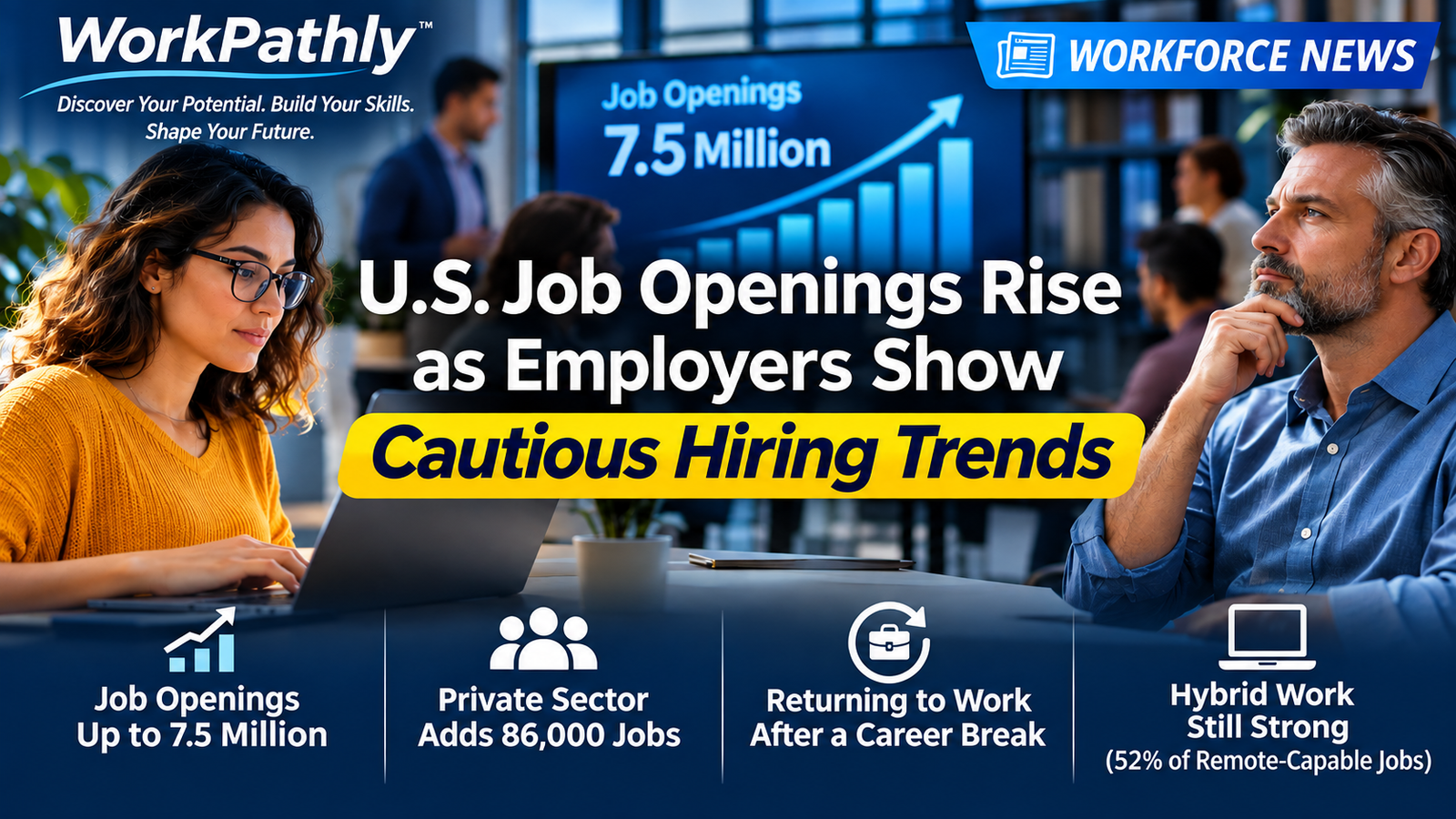
The U.S. labor market continues to show a mixed picture. Government data points to approximately 7.5 million job openings in September, while private-sector employment increased by 86,000 jobs in October, according to ADP. At the same time, professionals returning to work after career breaks face challenges that require new strategies, and hybrid work remains a major part of the employment landscape.
Here are four workforce developments worth following this week, along with practical insights for job seekers and professionals.
1. U.S. Job Openings Reach 7.5 Million as Hiring Remains Cautious
The U.S. Bureau of Labor Statistics (BLS) reported approximately 7.5 million job openings in September 2026 in its latest Job Openings and Labor Turnover Survey (JOLTS), released on November 3.
The detailed figures show 7.523 million available positions, compared with a revised 7.2 million in August. Employers reported approximately 5.4 million hires during September, while total separations reached 5.3 million.
Layoffs and discharges stood at approximately 1.6 million. Voluntary quits increased to 3.4 million, suggesting that some workers continued to leave their positions voluntarily.
Although the number of openings remains substantial, hiring activity has not accelerated dramatically. This points to a labor market in which opportunities exist, but employers may still be selective when filling positions.
Why this matters
For job seekers, the figures suggest that opportunities remain available across the economy. However, having a strong resume, relevant skills, and a targeted job-search strategy is increasingly important. Candidates should research industries and employers rather than relying exclusively on general job-market headlines.
Sources:
- U.S. Bureau of Labor Statistics – Job Openings and Labor Turnover Survey
- Reuters – U.S. Job Openings Jump in September; Layoffs Lowest in 1½ Years
2. Private-Sector Employers Add 86,000 Jobs in October, ADP Reports
Private-sector employment in the United States increased by 86,000 jobs in October, according to the ADP National Employment Report released on November 4.
The report was produced by ADP Research in collaboration with the Stanford Digital Economy Lab. It is based on anonymized payroll data from more than 26 million private-sector employees.
Hiring was distributed across several industries, although results varied considerably:
- Trade, transportation, and utilities: 39,000 jobs added.
- Education and health services: 28,000 jobs added.
- Leisure and hospitality: 19,000 jobs added.
- Financial activities: 15,000 jobs added.
- Professional and business services: 27,000 jobs lost.
ADP also reported that base pay increased by 3.2% year over year across private-sector workers. Employees changing jobs experienced median base-pay growth of 4.8%, compared with 3.0% for those who remained with their employers.
It is important to distinguish the ADP report from the official government employment report. ADP uses its own payroll data and methodology, so its monthly estimates can differ from the figures subsequently published by the Bureau of Labor Statistics.
Why this matters
The results show that hiring continues, but not equally across all industries. Job seekers may benefit from exploring sectors showing stronger employment activity, while professionals in industries experiencing reductions may want to strengthen transferable skills and consider additional career options.
Source: ADP – National Employment Report, October 2026.
Additional reporting: Reuters – U.S. Private Payrolls Rise in October, ADP Says.
3. Returning to Work After a Career Break: Why Previous Experience Still Matters
Returning to paid employment after several years away from the workforce can be challenging. A report published by The Washington Post on November 4 examines the experience of professionals returning after extended caregiving breaks.
One example follows a professional who returned to employment after seven years of caregiving. Her transition involved moving from early-childhood education into financial services, beginning in an entry-level position and gradually developing a new career path.
The report highlights an important point: time away from traditional employment does not necessarily erase professional abilities.
Skills developed through caregiving, previous employment, volunteering, and personal projects can often be relevant to new positions. Time management, organization, communication, problem-solving, and handling complex relationships are examples of abilities that may transfer to professional environments.
Practical strategies for returning workers
- Identify transferable skills developed through previous work and personal responsibilities.
- Reconnect with former colleagues and professional contacts.
- Update your resume and LinkedIn profile to highlight relevant abilities.
- Consider temporary assignments, contract work, and return-to-work programs.
- Explore opportunities in industries different from your previous career.
- Be realistic about the possibility of starting in a different position while rebuilding experience.
Why this matters
Career breaks do not have to represent the end of professional development. With a clear strategy, people returning to employment can recognize their existing strengths, identify missing qualifications, and gradually build a new professional path.
Source: The Washington Post – Headed Back to Work From Full-Time Caregiving? Here’s How to Find Your Footing.
4. Hybrid Work Remains a Major Part of the U.S. Employment Landscape
Despite continued discussions about returning employees to traditional offices, hybrid work remains the most common arrangement among U.S. employees whose positions can be performed remotely.
According to Gallup research updated on September 28, 2026, the distribution among remote-capable U.S. employees was:
- 52%: Hybrid work.
- 26%: Fully remote work.
- 22%: Fully on-site work.
Gallup reports that these proportions have remained relatively stable since mid-2022. The findings suggest that remote and hybrid arrangements continue to play an important role in the modern workforce.
Why this matters
People looking for flexible employment should not limit their searches to positions advertised as fully remote. Hybrid opportunities can also provide flexibility and may be available in professional services, administration, technology, finance, and other occupations.
Understanding the differences between remote, hybrid, and on-site arrangements can help candidates identify positions that better match their professional goals and personal circumstances.
Source: Gallup – Hybrid Work and Productivity: What the Data Show.
What Job Seekers Should Take Away From This Week’s News
The latest developments point to a labor market with available opportunities, but also important challenges. Employers continue to hire, although activity differs across industries. At the same time, career flexibility, transferable skills, and professional development remain valuable assets.
For people looking for work, the following actions can make a difference:
- Expand your search: Consider on-site, hybrid, and remote positions.
- Recognize transferable skills: Previous professional and personal experiences may qualify you for opportunities in different industries.
- Keep learning: Digital skills, communication, problem-solving, and adaptability can strengthen your professional profile.
- Prepare strategically: Tailor your resume and application to each position instead of sending the same materials everywhere.
- Follow labor-market developments: Employment conditions can change across industries, regions, and occupations.
The central message is clear: building a stronger professional future requires more than finding an available job. It also involves developing skills, recognizing opportunities, and adapting to a changing workforce.
Stay informed with WorkPathly. Explore career guidance, employment opportunities, professional development resources, and practical advice to help shape your next career move.
Editorial note: This weekly roundup was prepared using information published by the U.S. Bureau of Labor Statistics, ADP, Reuters, The Washington Post, and Gallup. Employment figures and research findings are attributed to their respective sources. ADP’s private-sector employment estimate is an independent measure and is not an official government payroll figure.