Remote Work Is Here to Stay — But Finding the Right Job Takes Strategy

Remote work continues to shape how many Americans approach their careers. But finding the right opportunity takes more than searching for jobs with the word "remote" in the title.
Understanding employment data, recognizing the differences between work arrangements, and evaluating job listings carefully can help candidates make better career decisions.
What the Data Tell Us
The U.S. Bureau of Labor Statistics (BLS) and Gallup study work arrangements from different perspectives. Their figures help illustrate why it is important to understand who is being measured before drawing conclusions about the labor market.
The BLS reports telework among employed people, while Gallup examines employees whose jobs can be performed remotely. These are different populations, so their percentages should not be directly compared.
Remote, Hybrid, and On-Site Work
The term "remote work" does not mean the same thing at every company. Employers may have different policies about where employees can live, when they must be available, and whether they need to visit an office.
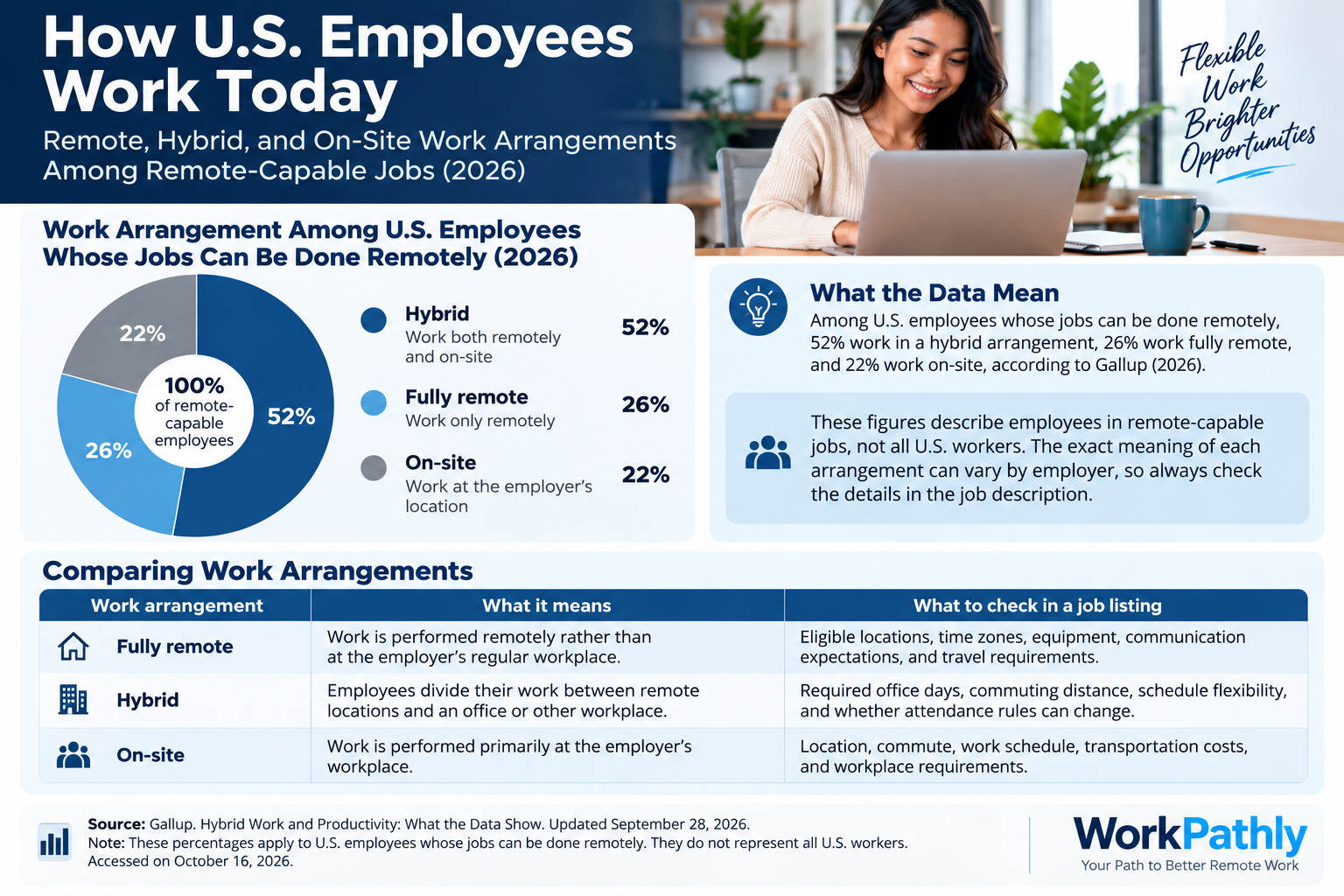
| Work type | What it means | What to check in a job listing |
|---|---|---|
| Fully remote | Work is performed remotely rather than primarily at the employer's regular workplace. | Eligible locations, time zones, equipment, communication expectations, and travel requirements. |
| Hybrid | Employees divide their work between remote locations and an office or other workplace. | Required office days, commuting distance, schedule flexibility, and attendance rules. |
| On-site | Work is performed primarily at the employer's workplace. | Location, commute, schedule, transportation costs, and workplace requirements. |
The table provides general definitions. An employer's own policy and the individual job description determine the actual requirements.
Understanding the Numbers
According to Gallup, among U.S. employees whose jobs can be performed remotely, 52% work in a hybrid arrangement, 26% work exclusively remotely, and 22% work on-site. These figures, based on May 2026 data, show that hybrid work remains the most common arrangement among remote-capable employees.
The U.S. Bureau of Labor Statistics reported that 21.9% of employed people at work in September 2026 had teleworked or worked at home for pay. This measure covers a different population and uses a different definition from Gallup's remote-capable workforce data.
The key takeaway: remote and hybrid work are significant parts of the U.S. labor market, but the figures should not be treated as directly comparable. Job seekers should evaluate the actual location policy, eligibility requirements, and schedule of each position.
Sources: Gallup — Hybrid Work and Productivity and U.S. Bureau of Labor Statistics — Employment Situation, Table A-41.
Five Ways to Improve Your Remote Job Search
1. Read the full job description
Check whether the position is fully remote, hybrid, or location-dependent. Some remote jobs are restricted to applicants living in specific states or regions. Confirm time-zone expectations and required working hours before applying.
2. Tailor your resume
Highlight the experience and skills that directly match the role. Written communication, organization, customer service, digital collaboration, and independent task management may be relevant to some remote positions. Include only skills you can demonstrate honestly.
3. Prepare examples for interviews
Think of specific situations in which you solved a problem, met a deadline, communicated with colleagues, or managed competing priorities. Concrete examples help employers understand how you work.
4. Evaluate the entire offer
Look beyond the remote-work label. Consider compensation, benefits, employment status, equipment, schedule, training, and opportunities for development. Confirm any office attendance or travel requirements.
5. Verify the employer
Research the company and, when possible, apply through its official careers website. Be cautious of requests to pay hiring fees, deposit checks to purchase equipment, or provide sensitive financial information before a legitimate hiring process.
What This Means for Job Seekers
Remote and hybrid work can offer flexibility, but neither arrangement is suitable for every occupation or every person. Availability depends on the role, employer, location, skills, and business requirements.
The most useful strategy is to identify your priorities, target positions that fit your experience, and verify the actual terms of each opportunity. A carefully prepared application for a suitable role can be more effective than sending the same resume to many unrelated vacancies.
At WorkPathly, our goal is to help readers understand employment trends and turn reliable information into practical career decisions. Explore our resources, strengthen your applications, and keep developing the skills that are relevant to your chosen field.
Sources and References
U.S. Bureau of Labor Statistics (BLS) Employment Situation — people at work by telework status and selected characteristics. BLS Employment Situation
Gallup Hybrid Work and Productivity: What the Data Show. Gallup workplace research
Editorial note: The BLS and Gallup figures describe different populations and measures. They should not be interpreted as directly comparable estimates. Readers should consult the original publications for definitions, methodology, and updates.
Information reviewed on October 16, 2026.